

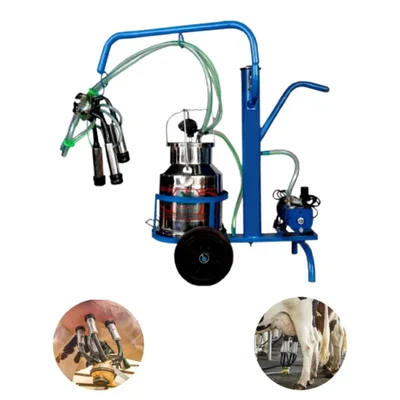



Open Door Trolley Type 0.5 HP Single Bucket Milking Machine With 20 Liters Stainless Steel Bucket

 927 people have viewed this recently
  Estimated Delivery By: Sep 18 - Sep 20
& Refund

Assurance

Delivery

Assistance

Protection
Short Description
With 0.5 HP Motor & 150 LPM Vacuum Pump
With 20 Liters Stainless Steel 304 Bucket
1 Year Warranty on Motor & Pump
Specifications
- Brand: Open Door
- Material : Stainless Steel
- Weight (Approx.) : 38 kg
- Model : Trolley Pro
- Motor Power : 0.5 HP
- Phase : Single
- Pump : 150 LPM Monoblock
- Bucket Capacity : 20 Liters
- Vacuum Pipe : 20 feet (6 m)
- Suitable for : 1 to 8 Cows & Buffaloes
- Milking Process Time : 5 to 6 mins for complete milking
- Pulsator : Stainless Steel and waterproof
- Easy run on inverter
- Trolley Material : High Carbonic Iron
- Size of Trolley (L x W x H) : 55 x 48 x 65 cm
Description
Features
:- User-Friendly Operation : Equipped with intuitive controls, trolley type milking machine is designed for straightforward operation, reducing training time for new users.
- Efficient Milking Process : The integration of advanced technology leads to a faster milking process, reducing the time spent per cow while maximally extracting milk.
- Reduced Labor Intensity : By automating the milking process, these machines decrease the physical strain on operators and reduce the overall labor required for milking.
Accessories
:- Claw
- Vacuum pipe
- Milking Pipe
- Cluster
- Vacuum Gauge
- Cleaning brush
- Vacuum pump oil
Applications
:Commercial Dairy Farms: Automatic milking machine is an important pieces of equipment at dairy farms, because this machine automates the milking process and increases the milking efficiency.
Reduced Dependence On Skilled Labor: The milking machine reduces the dependence on skilled labor for milking operations, making the task more efficient and cost effective and let's anyone take control over the milking operation without the need of having the required skillset to milk a cow.
Improved Milk Quality and Hygiene: Using an automatic milking machine helps ensure cleaner milk by minimizing contamination risks that can occur during hand milking. The enclosed system reduces the likelihood of dirt, debris, or manure entering the milk, which is crucial for maintaining high-quality standards in dairy production.
Usage
:Prepare the Milking Area :
- Prepare the Cows for Milking :
Hygiene : Clean the udder and teats thoroughly with warm water and a sanitizing solution to minimize the risk of infection.
Calm the Animals : Keep the environment quiet and stress-free, and handle the cows gently to ensure their comfort.
- Adjust the Machine Settings :
Select the Right Pulsation Rate : This is usually specified in the manual and can differ between different lactation stages of cows.
Set the Milk Flow Rate : Adjust according to the cow’s milking speed and to prevent machine overload. Attach the Milking Clusters :
Connect the milking clusters to the cows following these steps :
Positioning : Approach the cow calmly and position the milking cluster directly below the udder.
Attachment : Carefully attach the teat cups to each teat, ensuring a snug fit without applying too much pressure.
Check for Proper Seal : Ensure there is no leakage or improper positioning of the cups.
- Monitor the Milking Process :
Observe Cow Behavior : Ensure the cow is comfortable and relaxed.
Observe the Milk Flow : While conducting the milking process, observe the flow rate of the milk and make sure that uniform flow is maintained.
- Detach the Clusters :
Clean the Milking Equipment: Rinse and sanitize all milking components, including the milking cluster and the storage tank, to prevent bacteria growth.
Routine Inspections: Conduct daily checks for wear and tear, ensuring all components are functioning properly.
Scheduled Maintenance: Ensure lubrication, parts replacement, and deep cleaning to keep machinery in peak condition.

 AI-generated answers may be inaccurate. Double-check critical facts.