

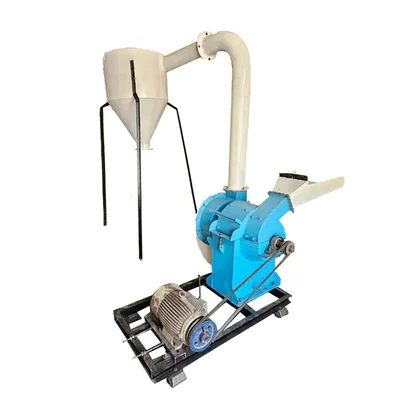


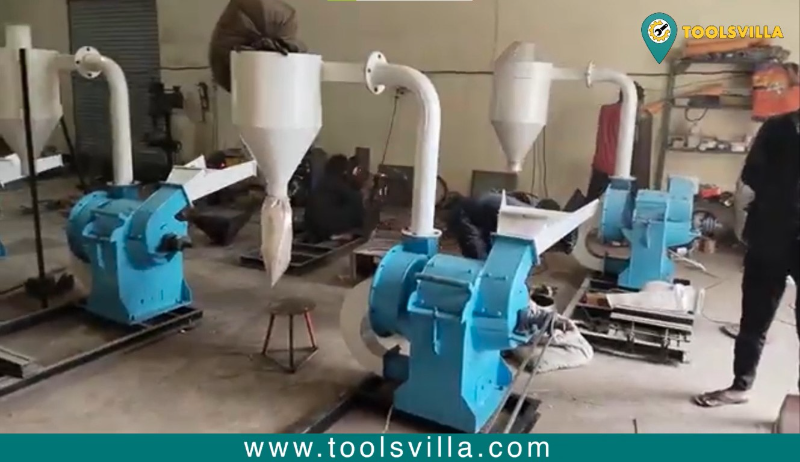



Automatic 40 HP Rice Husk Grinder For Biomass Materials, Cattle Feed, Poultry Feed, Agricultural Waste

 1144 people have viewed this recently
  Estimated Delivery By: Oct 20 - Oct 22
& Refund

Assurance

Delivery

Assistance

Protection
Short Description
Specifications
- Brand: Generic ( Made in India )
- Weight (Approx.) : 800 kg
- Material : Mild Steel
- Motor power - 40 HP
- First Chamber size - 8" * 10"
- Second Chamber size- 10" * 22"
- Production per hr - 300-400 KG /HR (depends on material)
- RPM- 2880
- Space Required - 10' * 10' * 12'
Description
Features
:- Motor Power: 40 HP electric motor, providing substantial power for heavy-duty grinding.
- High Capacity: Its High Capacity generally capable of processing a significant amount of rice husk, often ranging from 300 kg/hr to 400 kg/hr.
- Material of Construction: It is made from Mild Steel for robust construction and durability. Some parts might be stainless steel for hygiene or corrosion resistance.
Applications
:The Rice Husk Grinding Machine is ideal for processing a variety of agricultural and industrial materials. It is specifically suited for:
- Rice Husk Pulverizing – Converts rice husk into fine powder for use in biomass fuel, fertilizer, or particle board manufacturing.
- Animal Feed Preparation – Grinds husk and other grains for feed.
- Biomass Briquette Production – Prepares material for fuel briquettes and pellets.
- Agro-Waste Management – Helps reduce agro-waste by converting it into usable forms.
- Industrial Filler Production – Can be used in making fillers for construction and insulation materials.
- Soil Amendments - Preparing material for biochar production or as an organic additive to improve soil structure.
Usage
:The typical usage of this product:
1. Preparation of Raw Material (Rice Husks):
Feeding: Raw rice husks are fed into the machine's in-feed hopper. This is often done manually for smaller operations or through an automated conveyor system for larger industrial setups.
Initial Grinding (First Chamber): The husks first enter the 8" x 10" chamber, where they undergo an initial, coarser grinding. High-speed rotating hammers or beaters inside this chamber break down the husks into smaller fragments.
- Fine Grinding (Second Chamber): The partially ground material then moves into the larger 10" x 22" second chamber. Here, further pulverization occurs, often with finer screens and more intensive hammering, reducing the material to the desired particle size.
- Sizing and Discharge: A screen at the outlet of the second chamber ensures that only particles of the desired fineness pass through. Oversized particles are retained within the chamber for further grinding. The finely ground rice husk powder is then discharged from the machine, typically collected in bags, silos, or conveyed to the next processing stage.
Increased Surface Area: Grinding vastly increases the surface area of the husks, making them more reactive and efficient for subsequent processes (e.g., combustion, chemical reactions, absorption).
- Improved Handling and Storage: Powdered husks are easier to handle, transport, and store compared to bulky raw husks. They can be more readily conveyed through pneumatic or mechanical systems.
- Enhanced Mixing: Ground material mixes more uniformly with other ingredients in applications like animal feed or construction materials.
- Process Efficiency: Many industrial processes require a fine, consistent particle size for optimal performance (e.g., briquetting, pelletizing, gasification).
For Biofuel & Energy:
Directly fed into specialized boilers or gasifiers as a fuel source. Mixed with binders and pressed into briquettes or pellets for concentrated biofuel. Used as feedstock for biochar production.For Agriculture:
Blended into animal feed formulations as a fiber source.
Mixed into potting media or soilless growing systems.
Incorporated into compost or directly applied to soil as a soil amendment (especially after being converted to biochar).
For Construction:
After controlled burning to produce Rice Husk Ash (RHA), the RHA is used as a supplementary cementitious material in concrete and mortar.
Used as a lightweight filler in various construction materials.
For Industrial Products:
As a raw material for activated carbon production.
As a filler in plastics, rubber, or composites.
As an absorbent for spills.
In the production of specialized chemicals or silica-based products.
The finely ground rice husk powder produced by this machine is then used as a raw material or input in a variety of industries:

 AI-generated answers may be inaccurate. Double-check critical facts.