



Brand: Reliant Lab
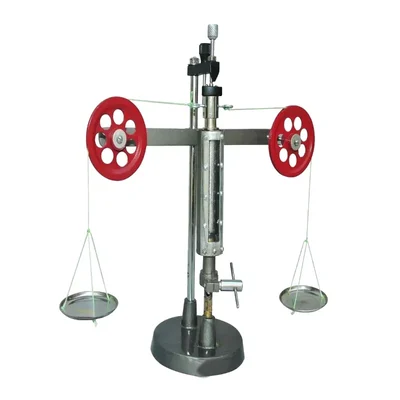
Reliant Lab Mayers Viscosity Apparatus for Molecular Diameter Calculation
SKU: TB-RE-67230 Estimated Delivery By: Oct 14 - Oct 16




MRP : ₹4999 ₹3869
23% OFF!
Estimated Delivery By: Oct 14 - Oct 16 Easy Return
& Refund
& Refund
Quality
Assurance
Assurance
Trusted
Delivery
Delivery
After Sales
Assistance
Assistance
Buyer
Protection
Protection
₹3869 (Including GST)
MRP : ₹4999
23% OFF!
Get Extra ₹58 OFF on Prepaid Orders
QTY :
-
1
+
Short Description
Reliant Lab Mayers Viscosity Apparatus
For Molecular Diameter Calculation
Country of origin: India
Specifications
- Brand: Reliant Lab
- Product Quantity : 1 Piece
Description
The Reliant Lab Mayer’s Viscosity Apparatus is a specialized physical chemistry instrument used to determine the viscosity of gases, most commonly air. Unlike falling ball viscometers used for liquids, this apparatus employs the principle of capillary flow adapted for gaseous mediums. The setup typically involves a constant pressure aspirator or a mercury-column system that drives a known volume of gas through a fine glass capillary tube. By measuring the rate of flow and the pressure difference across the capillary, the coefficient of viscosity for the gas can be calculated with high precision.
Features
:- Precision Capillary Bore: Features a high quality, uniform diameter glass capillary tube designed to ensure laminar flow of the gas.
- Constant Pressure Head: Utilizes a regulated reservoir or aspirator system to maintain a steady driving force throughout the experiment.
- Temperature Jacket Compatibility: The capillary is often housed within a protective sleeve that can be connected to a water bath for temperature dependent studies.
- Borosilicate Glass Construction: All glass components are made from low-expansion borosilicate glass to prevent dimensional changes due to temperature fluctuations.
Applications
:- Gas Characterization: Determining the viscosity of different gases such as air, nitrogen, or carbon dioxide under varying conditions.
- Temperature Viscosity Relationship: Investigating how the viscosity of a gas increases with temperature, a contrast to the behavior of liquids.
- Molecular Diameter Calculation: Providing the empirical data necessary to estimate the mean free path and effective diameter of gas molecules.
- Chemical Engineering: Data collected is vital for designing gas transport systems and understanding fluid dynamics in industrial piping.
Ask AI

 AI-generated answers may be inaccurate. Double-check critical facts.
 Questions & Answers (0)

Select attribute